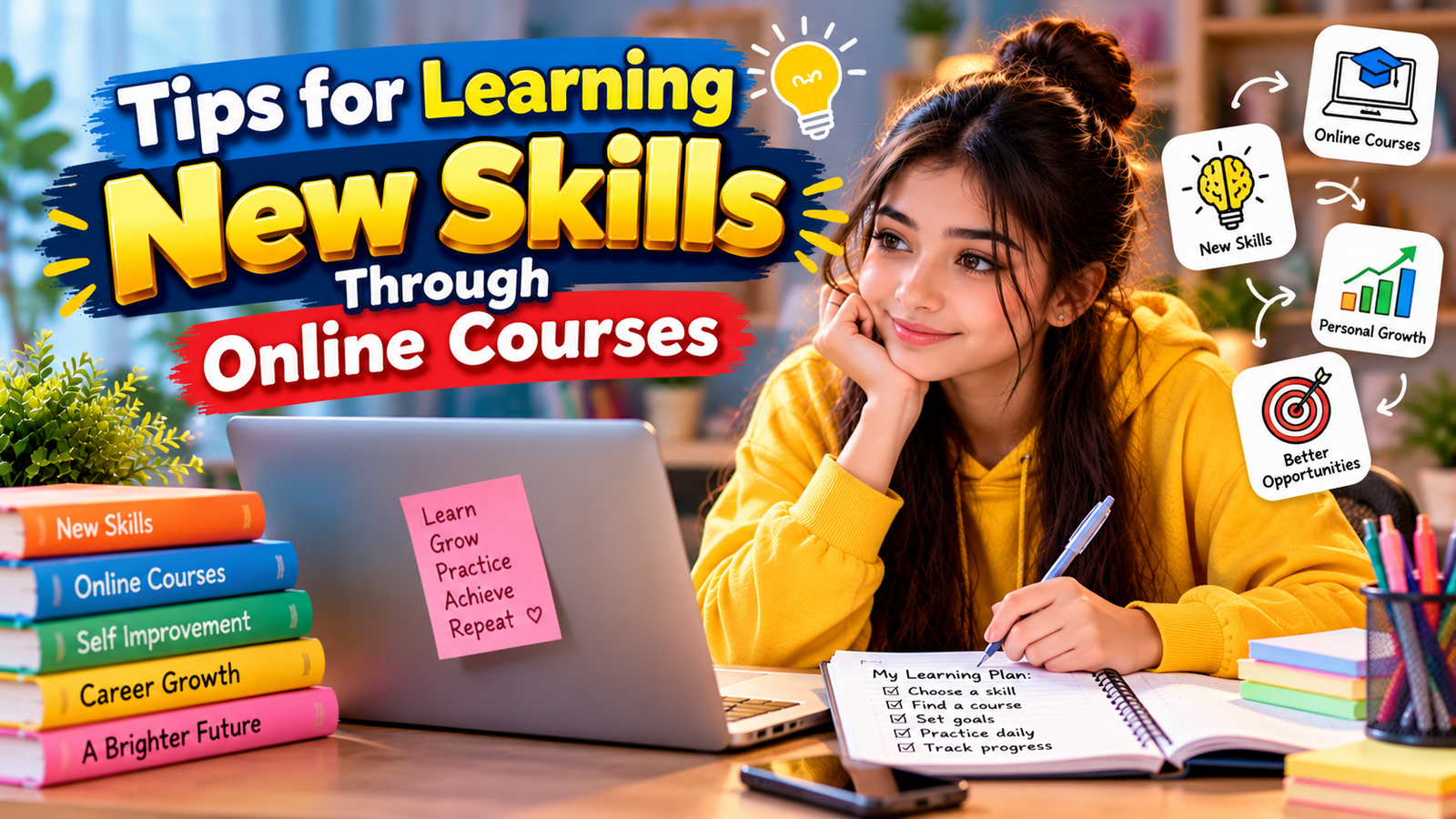
Learning new skills has become easier because of the availability of online courses. Students, professionals, and beginners can now learn programming, graphic design, digital marketing, writing, communication, and many other skills from home. Online learning provides flexibility and allows people to study according to their schedules and personal goals.
In my opinion, online courses are a valuable way to improve knowledge and develop practical abilities without always needing to attend a physical classroom. However, enrolling in a course does not automatically mean that you will master a new skill. Real progress requires consistency, practice, patience, and a clear learning plan.
Some learners complete several courses but struggle to apply what they have learned. Others start enthusiastically but stop when lessons become difficult. These problems can often be reduced by choosing suitable courses and following an organized learning routine.
In this article, I will share practical tips for learning new skills through online courses and explain how to turn online lessons into useful knowledge.
Why Are Online Courses Useful for Learning New Skills?
Online courses give learners access to educational materials from different instructors and platforms. Depending on the course, students may receive recorded lectures, written lessons, practice exercises, quizzes, assignments, and certificates.
One major advantage is flexibility. You can study in the morning, during your free time, or after completing your regular responsibilities. Many platforms also provide introductory courses that allow beginners to explore a subject before making a financial commitment.
Online learning can be especially useful when you want to develop a skill that is not taught in your regular academic program. For example, a university student might learn web development, presentation design, or spreadsheet management alongside their degree.
However, it is important to remember that different skills require different amounts of practice. Understanding a programming tutorial is not the same as being able to build a working application independently.
The goal should be to develop practical ability rather than simply collect completed courses.
1. Set a Clear Learning Goal
Before enrolling in an online course, decide what you want to achieve. A clear goal helps you choose relevant lessons and measure your progress.
For example, instead of saying that you want to learn programming, set a more specific goal such as learning Python fundamentals and building a small project.
Similarly, if you want to improve your graphic design skills, you might aim to create a simple social media post, presentation, or poster using a design application.
I believe specific goals make learning more manageable because they provide a clear direction. You know what you are working toward and can identify which lessons are relevant.
Write your goal somewhere visible and divide it into smaller milestones. Completing one milestone at a time can help you maintain motivation throughout the learning process.
2. Choose the Right Online Course
Selecting the right course is an important step in learning a new skill. Before enrolling, review the course description, learning objectives, instructor information, and required experience level.
Beginners should usually start with introductory material instead of immediately choosing an advanced course.
For example, if you have never programmed before, a beginner Python course is likely to be more useful than an advanced course focused on complex software development.
Check the course curriculum to see whether it covers the topics you want to learn. Reading student reviews may also help you understand the teaching style and course structure.
You can explore educational resources on platforms such as Coursera, edX, Khan Academy, and freeCodeCamp. The availability of free lessons, certificates, and additional features varies by platform and course.
Do not choose a course simply because it is popular. Choose one that matches your current knowledge, available time, and learning objectives.
3. Create a Realistic Learning Schedule
Consistency is often more useful than studying for many hours on only one day. A realistic schedule helps you make steady progress without neglecting your other responsibilities.
Start by deciding how much time you can comfortably dedicate to learning each week. You might begin with twenty or thirty minutes a day, depending on your routine.
Choose a regular time when you can concentrate. Some learners prefer studying in the morning, while others find evenings more convenient.
Add your learning sessions to a calendar and treat them as important appointments. If you miss one session, adjust your schedule rather than abandoning the entire plan.
For example, you could watch a lesson on Monday, practice the material on Tuesday, and review your progress on Wednesday.
A flexible schedule is important because unexpected responsibilities can arise. The aim is to maintain a habit that you can continue over time.
4. Learn by Practicing, Not Just Watching
One of the most important tips for learning new skills through online courses is to practice what you learn.
Watching videos can help you understand concepts, but practical activities allow you to apply those concepts independently.
If you are learning programming, write your own code instead of only watching the instructor type. If you are learning graphic design, create original designs using the techniques demonstrated in the lessons.
For writing skills, practice producing short articles or paragraphs. If you are learning a language, use new vocabulary in sentences and conversations.
Practice also reveals gaps in your understanding. You may believe that you understand a concept while watching a lesson, but applying it without assistance can be more challenging.
Do not become discouraged when you make mistakes. Correcting errors is a normal part of developing a new skill.
5. Take Notes During Online Lessons
Taking notes can help you remember important concepts and return to them when needed.
You do not need to record every sentence from an online lesson. Focus on definitions, important steps, useful examples, and questions that require further explanation.
For example, while learning Excel, you could write down how a formula works and include a small example showing when to use it.
If you are learning web development, maintain notes about HTML elements, CSS properties, and common programming errors.
You can use a notebook or digital tools such as Google Docs and Microsoft OneNote to organize your learning materials.
Keep your notes clear and easy to search. Include the course name and topic so you can quickly locate the information later.
Reviewing notes before a practice session can help refresh your memory and make it easier to apply what you have learned.
6. Divide Difficult Topics Into Smaller Steps
Some online courses introduce complex ideas that can feel overwhelming at first. Trying to understand everything immediately may lead to frustration.
A better approach is to divide difficult topics into smaller sections.
For example, someone learning web development could begin with HTML structure, then move to CSS styling, and later explore JavaScript interactions.
After understanding each section, practice it before moving forward. This creates a stronger foundation for more advanced topics.
You can also revisit earlier lessons when a new concept depends on information you have already studied.
In my view, learning at a steady pace is more useful than rushing through an entire course without understanding the material.
Everyone learns differently, so do not compare your progress too closely with another person’s timeline.
7. Build Small Projects
Projects help transform theoretical knowledge into practical skills. They also give you something concrete to evaluate and improve.
If you are learning programming, create a calculator, quiz application, or simple personal website. If you are studying graphic design, prepare a collection of posters or social media graphics.
For digital marketing, you could develop a sample content calendar for an imaginary business. For writing, create a small portfolio containing several original articles.
Start with projects that match your current ability. You can gradually increase the difficulty as your confidence improves.
When a project becomes challenging, break it into smaller tasks and solve one problem at a time.
Keep your completed projects organized so you can review your progress. A collection of practical work may also help demonstrate your abilities when applying for internships or entry level opportunities.
8. Use Free Learning Resources Wisely
Online courses are valuable, but they are not the only sources of learning. Free documentation, educational articles, tutorials, practice websites, and discussion communities can provide additional explanations.
For example, someone learning Python can consult the official Python documentation when a particular function is unclear. A student learning design can explore free tutorials and practice with available design tools.
However, using too many resources at once can create confusion. Different instructors may explain the same concept in different ways, making it harder for beginners to decide which approach to follow.
I recommend choosing one main course and using additional resources only when you need clarification or more practice.
Always check whether the information is reliable and current, especially when learning software that changes over time.
9. Track Your Learning Progress
Tracking progress helps you understand whether your learning routine is working.
You can maintain a simple checklist of lessons completed, exercises practiced, and projects finished.
Instead of measuring progress only by the number of videos watched, consider what you can now do independently.
For example, after completing a beginner programming course, ask yourself whether you can write a simple program without copying the instructor’s solution.
If you are learning writing, review an earlier article and compare it with your more recent work. Look for improvements in organization, clarity, grammar, and research.
Celebrate small achievements while remaining realistic about your weaknesses.
Regular progress reviews can also help you decide whether to continue with your current course or spend additional time practicing specific topics.
10. Stay Motivated When Learning Becomes Difficult
Motivation often changes during the learning process. Beginners may feel excited at the beginning but become discouraged when lessons become more demanding.
This is normal. Developing a useful skill takes time, and progress may not always be immediately visible.
When you feel stuck, return to your original goal and identify one small task you can complete. You might revise a previous lesson, solve a simple exercise, or ask a question in an appropriate learning community.
Avoid enrolling in multiple courses simply because you feel that you are not progressing quickly enough. Completing one course and practicing its material may be more useful than starting several courses and leaving them unfinished.
Take breaks when necessary and recognize the progress you have already made.
A consistent learning routine can help you continue even on days when motivation is limited.
Common Mistakes to Avoid When Taking Online Courses
One common mistake is collecting certificates without developing practical abilities. Certificates may demonstrate course completion, but they do not automatically prove that you can perform a task independently.
Another mistake is skipping exercises to finish the course quickly. Practice is essential when learning technical, creative, and communication skills.
Students should also avoid comparing their progress with people who have different backgrounds and available study time.
Finally, be careful with courses that promise guaranteed employment or exceptional results without credible evidence. Review the curriculum, costs, and conditions before paying for a program.
Choose educational resources carefully and focus on the quality of your learning rather than the number of courses completed.
Conclusion
Learning new skills through online courses can be an effective way to improve your knowledge, develop practical abilities, and explore new career opportunities.
In my opinion, the best approach is to set a clear goal, choose a suitable course, follow a realistic schedule, and practice regularly. Taking notes, building small projects, and tracking progress can make the learning process more productive.
You do not need to master an entire subject in a few days. Focus on understanding one concept at a time and applying what you learn to practical tasks.
With patience and consistent effort, online courses can become a valuable part of your personal and professional development.