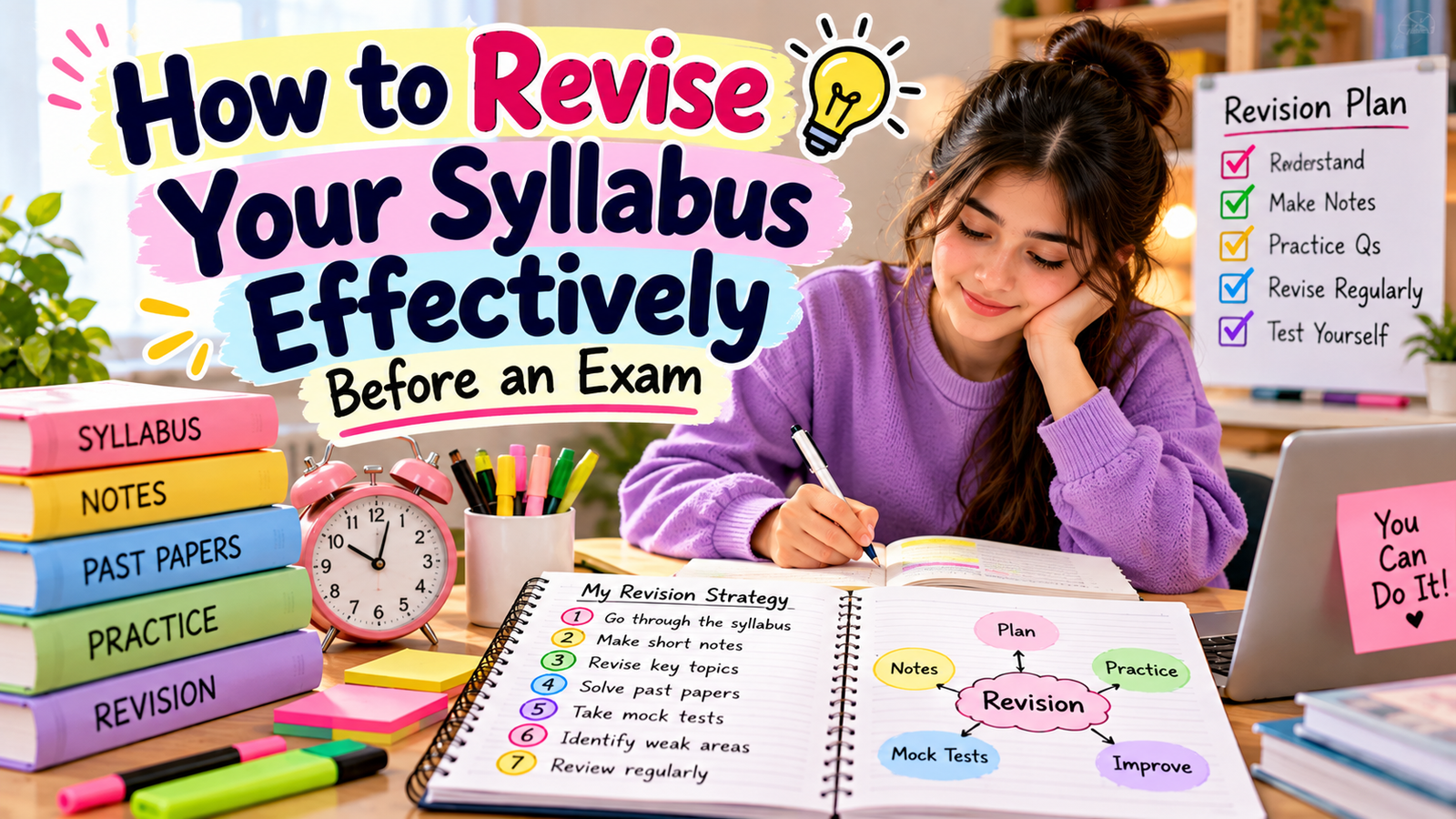
Revision is one of the most important parts of exam preparation. Students may spend weeks attending classes, reading textbooks, and making notes, but they can still struggle during an examination if they do not review what they have learned.
Effective syllabus revision is not simply about reading the same pages repeatedly. It involves remembering key concepts, identifying weak areas, practicing questions, and improving your ability to explain information without assistance.
In my opinion, the best revision strategy is one that combines proper planning with active learning. Every student has different strengths, so your revision method should match your subjects, available time, and learning needs.
1. Understand Your Complete Syllabus
Before starting revision, collect the official syllabus, course outline, textbooks, and class notes. Make a list of the chapters and topics included in the examination.
This step is important because students sometimes revise the chapters they enjoy while overlooking topics they find difficult.
Divide your syllabus into smaller sections. Mark each topic as well understood, partially understood, or requiring more study.
This classification helps you identify where to begin. Topics you already understand may need only a short review, while difficult chapters may require additional explanation and practice.
Check your teacher’s instructions and examination guidelines to understand which material is included. Avoid relying entirely on rumors about which questions will appear.
2. Create a Revision Timetable
A revision timetable helps you cover your syllabus systematically without wasting time deciding what to study next.
Write down your examination dates and calculate how much preparation time remains. Then divide your topics across the available days.
Give more time to subjects that are difficult, contain many chapters, or require regular problem solving.
For example, if you have ten chapters to revise in five days, you might review two chapters daily and reserve additional time for questions and weak areas. If some chapters are much longer than others, adjust the workload accordingly.
Include short revision sessions for previously studied topics. Revisiting information after an interval can help you remember it more effectively than studying everything once.
Keep your timetable flexible. If one topic takes longer than expected, rearrange your tasks rather than becoming discouraged.
3. Use Active Recall to Strengthen Memory
Active recall is a technique in which you attempt to retrieve information from memory without looking at your notes.
After reading a chapter, close your textbook and write down its main points. You can also explain the topic aloud, answer practice questions, or use flashcards.
Once you finish, compare your response with the original material. Pay attention to information you forgot or explained incorrectly.
This method gives you a more realistic picture of your preparation than repeatedly reading familiar sentences.
For example, after studying the causes of a historical event, try listing those causes from memory. After reviewing a biology chapter, draw and label a diagram without looking at the textbook.
Practice active recall regularly throughout your revision period.
4. Apply Spaced Revision
Spaced revision means reviewing information several times with intervals between sessions.
Instead of studying a topic once and leaving it until the examination, revisit it later that day, the next day, and again after a few days when your schedule allows.
The intervals do not need to follow a strict formula. What matters is that you give yourself opportunities to retrieve information after some time has passed.
Suppose you study a set of scientific definitions on Monday. You could test yourself again on Tuesday, review difficult definitions on Thursday, and complete a short practice test over the weekend.
This approach helps you discover whether information remains available in your memory.
It is particularly useful for vocabulary, formulas, definitions, historical dates, and other material that requires accurate recall.
5. Make Short and Useful Revision Notes
Revision notes should help you remember important information quickly. They do not need to reproduce every paragraph from your textbook.
Create concise summaries containing main ideas, essential definitions, formulas, examples, and important relationships between concepts.
Use headings and bullet points where helpful. Tables can be useful for comparing similar topics, while diagrams can make complex processes easier to understand.
For example, a science chapter might be summarized through a diagram and a list of key terms. A literature chapter might require character descriptions, themes, and supporting examples.
Avoid spending hours making your notes visually attractive. Good revision notes are valuable because they make information easier to review, not because they contain elaborate decoration.
6. Practice Past Papers and Sample Questions
Past papers are useful for understanding examination structure and testing your preparation.
They can show you how questions are worded, how marks are distributed, and how much detail may be expected in different answers.
Choose a paper that matches your course and try answering it without looking at your notes. Use a timer when appropriate.
Afterward, check your responses and identify recurring weaknesses.
If you repeatedly lose marks because you do not explain your reasoning, practice writing more complete answers. If you struggle with numerical questions, review the relevant methods and solve additional problems.
Remember that past papers are practice resources, not guarantees about future examination questions. Make sure your revision covers the required syllabus rather than only memorized answers.
7. Give Extra Attention to Weak Topics
One common revision mistake is spending most of your time on subjects you already understand because they feel comfortable.
Although reviewing familiar material is useful, improvement often comes from addressing areas where your knowledge is incomplete.
Use your practice results to identify specific weaknesses. Instead of writing that an entire subject is difficult, determine exactly which concepts, formulas, or question types cause problems.
Review the relevant explanation, study a worked example, and then attempt a similar question independently.
If you remain confused, ask your teacher or consult a reliable learning resource.
Work on difficult topics in manageable sessions. You do not need to solve every problem immediately to make progress.
8. Use Different Revision Methods for Different Subjects
Not every subject should be revised in exactly the same way.
Mathematics generally requires solving problems and understanding methods. Science may require definitions, diagrams, explanations, and numerical practice. History often involves understanding events, causes, consequences, and chronology.
Languages may require grammar exercises, vocabulary practice, reading comprehension, and written responses.
For essay based subjects, practice creating outlines and developing arguments supported by relevant information.
Think about what you will actually need to do during the examination. If you must solve equations, spend time solving them. If you must write essays, practice writing organized answers.
Matching your revision technique to the examination task makes your preparation more relevant.
9. Take Breaks and Maintain Healthy Habits
Long revision sessions without breaks can become tiring and unproductive.
Divide your study time into manageable blocks and take short breaks between them. During breaks, stretch, walk around, drink water, or rest your eyes.
Maintain regular meals and a consistent sleep schedule. Avoid sacrificing sleep to revise material that could have been covered through better planning.
A calm environment can also improve concentration. Keep your study area organized and reduce unnecessary phone notifications.
If you feel overwhelmed, choose one small task and complete it before deciding what to do next.
Healthy habits do not replace studying, but they can help you make better use of your study time.
10. Review Your Mistakes Before the Exam
Mistakes provide valuable information about what you need to revise.
Keep a notebook or checklist of questions you answered incorrectly, concepts you forgot, and instructions you misunderstood.
Review this list regularly instead of repeating entire chapters without a clear purpose.
Before the examination, revisit the most important mistakes and check whether you can now answer those questions independently.
Also practice reading questions carefully. Sometimes students lose marks not because they lack knowledge, but because they misunderstand what the question asks.
Make sure you can explain important concepts in your own words rather than recognizing them only when reading your notes.
Conclusion
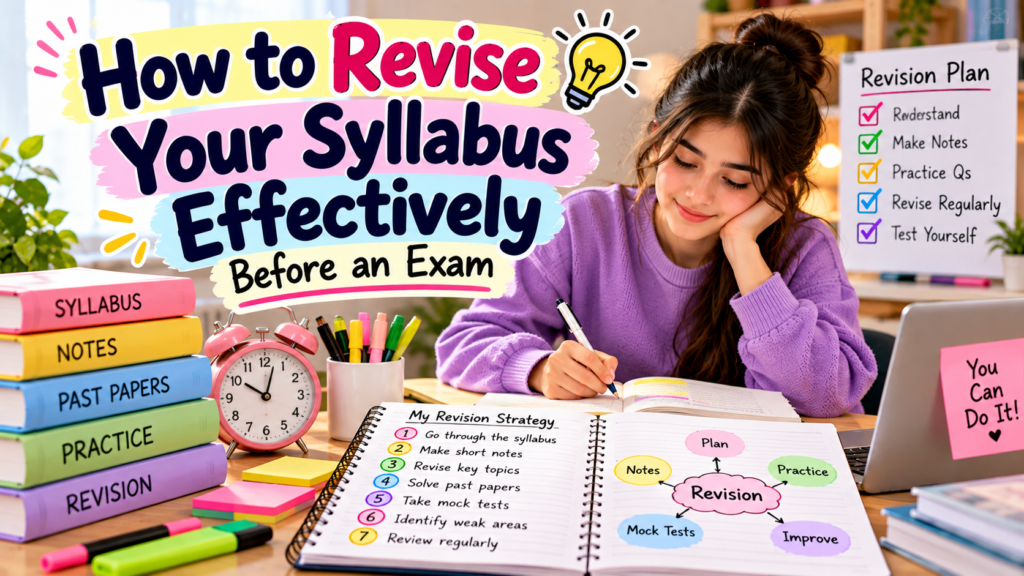
Learning how to revise your syllabus effectively before an exam requires a combination of planning, active recall, spaced revision, and practice questions.
Start by identifying the topics you need to cover. Organize them into a realistic timetable, spend additional time on weak areas, and test yourself regularly to measure progress.
In my view, effective revision is about understanding and remembering information rather than simply spending long hours with a textbook open.
If you revise consistently and learn from your mistakes, you can use your preparation time more effectively and enter the examination with greater confidence.
SEO title: How to Revise Your Syllabus Effectively Before an Exam
Focus keyword: How to revise your syllabus effectively before an exam
Meta description: Discover effective syllabus revision tips using active recall, spaced repetition, past papers, revision notes, and a practical study timetable.
Suggested URL slug: revise-syllabus-effectively-before-exam