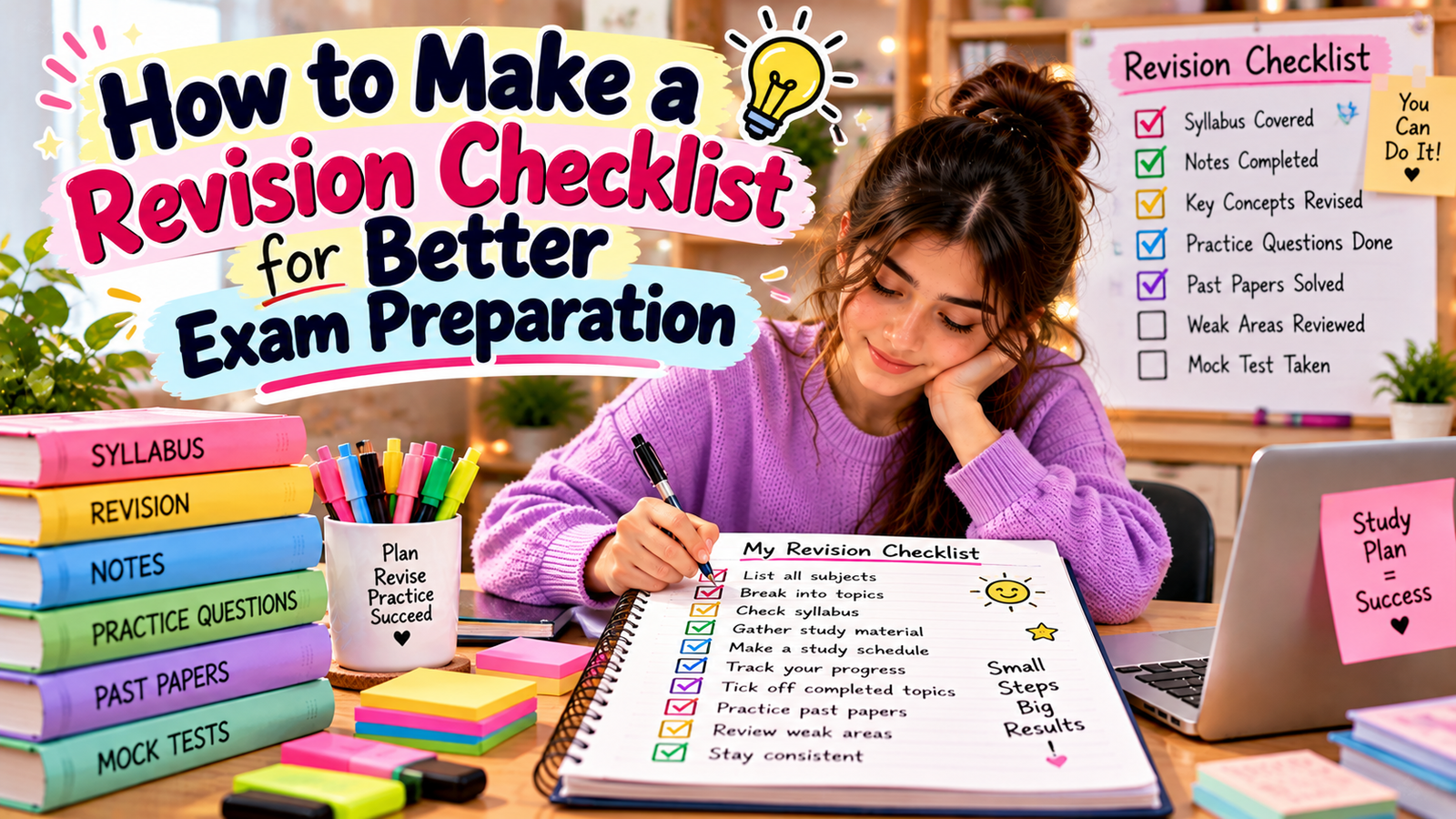
Preparing for an examination becomes easier when you know exactly what needs to be studied. Without a clear plan, students may forget important chapters, repeatedly revise familiar topics, or discover unfinished work just before the examination.
A revision checklist is a simple tool that helps you organize your syllabus, track your progress, and identify areas that require additional attention.
In my opinion, students do not need complicated planning systems to prepare effectively. A notebook, a printed syllabus, or a basic digital document can be enough to create a useful revision checklist.
1. Start With Your Official Syllabus
The first step is to collect the official syllabus for each upcoming examination.
Write down every subject and divide it into chapters, units, or individual topics. Use your textbook and class notes to check that you have included the required material.
For example, a mathematics checklist might contain algebra, geometry, equations, and statistics. A biology checklist might include cell structure, nutrition, respiration, and reproduction.
Use the exact topics relevant to your course rather than copying a general list from the internet.
Having the complete syllabus in one place reduces the chance of overlooking important material.
2. Divide Large Topics Into Smaller Tasks
A checklist becomes more useful when each task is specific.
Instead of writing “complete science,” divide the subject into manageable actions such as revising a chapter, learning important definitions, practicing diagrams, and answering sample questions.
Smaller tasks make progress easier to measure.
For example, a large chapter could be divided into reading the explanation, reviewing key terms, answering five questions, and correcting mistakes.
Choose tasks that can reasonably be completed in one study session or a small number of sessions.
This prevents your checklist from becoming a collection of vague goals that are difficult to finish.
3. Use Simple Progress Categories
Create a system that shows your progress clearly.
You can use three categories:
- Not started
- Needs revision
- Ready for practice
Move each topic between categories as your understanding improves.
A topic should not be marked ready simply because you have read it once. Test yourself with questions or explain the concept without looking at your notes.
If you forget important information, return the topic to the needs revision category.
This approach helps you make decisions based on your understanding rather than the amount of time you have spent reading.
4. Prioritize Difficult and Important Topics
Not every topic requires the same amount of revision.
Some chapters may be easy for you, while others need more practice. Some topics may also be particularly important because they form the foundation for later concepts.
Identify these differences when preparing your checklist.
Give extra attention to areas that you find difficult, especially when they are included in your upcoming examination.
However, do not assume that a topic can be ignored simply because you think it is unlikely to appear. Use the official syllabus and your teacher’s guidance to make informed decisions.
A balanced checklist should cover the required material while allowing more time for challenging areas.
5. Add Deadlines to Your Checklist
A revision checklist is more effective when it includes target dates.
Check your examination timetable and decide when each topic should be completed.
For example, you might plan to finish the first three chapters by Tuesday, revise the next two chapters by Thursday, and attempt a practice paper on Saturday.
Leave some flexibility for unexpected difficulties. If a chapter takes longer than expected, adjust your schedule rather than trying to complete every task at the same time.
Avoid setting too many deadlines for one day. A manageable workload is easier to follow consistently.
6. Include Practice Questions
Revision should involve more than reading and memorizing information.
Add practice questions to your checklist so that you can test whether you understand the material.
For each topic, you might include a short quiz, textbook exercises, a written answer, or a section from a past paper.
After completing the questions, check your answers and record any mistakes.
This gives you evidence of your progress and helps identify topics that need further revision.
If you repeatedly answer a question incorrectly, add a follow up task to review the underlying concept and try a similar question.
7. Track Mistakes Separately
Consider maintaining a small mistake list alongside your revision checklist.
Write down formulas you forget, concepts you misunderstand, and instructions you repeatedly overlook.
Keep the notes brief and specific.
For example, instead of writing “I am bad at mathematics,” record “Review the steps for solving quadratic equations.”
This turns a general concern into a practical action.
Review the mistake list every few days and check whether you can now answer those questions correctly.
Before the examination, this list can help you focus on the areas that need the most attention.
8. Choose a Checklist Format That Works for You
You can create a revision checklist using a notebook, spreadsheet, printed syllabus, or digital task list.
A notebook is useful if you prefer writing by hand. A spreadsheet can make it easier to organize multiple subjects, deadlines, and progress categories.
A digital checklist may be convenient if you need to access it from different devices.
Choose the simplest format that you will actually use. Spending hours designing an elaborate system can become another distraction from studying.
Keep your checklist easy to update and review.
9. Review Your Checklist Every Day
Spend a few minutes checking your progress at the end of each study day.
Mark completed tasks, identify unfinished work, and decide what to study next.
If you finish a task early, move to another useful activity. If a task takes longer than expected, adjust your schedule.
Do not treat an unfinished checkbox as a personal failure. The purpose of tracking progress is to help you make better decisions.
Regular review keeps your preparation organized and allows you to notice problems before the examination gets too close.
10. Use Your Checklist During Final Revision
As the examination approaches, your checklist can help you decide which topics need a final review.
Focus first on unfinished topics and areas where practice results show weaknesses.
Review familiar material briefly to maintain your understanding, but avoid spending all your time on topics you already know well.
Check that you have completed the required practice questions and reviewed important mistakes.
On the final day, use the checklist to guide light revision rather than attempting to complete an unrealistic amount of new work.
Example of a Simple Revision Checklist
| Task | Progress |
|---|---|
| Review Chapter 1 | Completed |
| Practice Chapter 2 questions | Needs revision |
| Memorize important definitions | Not started |
| Solve a sample paper | Not started |
| Review mistakes | Not started |
You can adapt this example to each subject and add target dates or notes when necessary.
Conclusion
A revision checklist can make exam preparation more organized by helping you divide your syllabus, prioritize difficult topics, practice questions, and monitor progress.
In my opinion, the most useful checklist is one that encourages action instead of creating unnecessary work. Keep it simple, update it honestly, and use it to decide what deserves your attention next.
When you know what you have completed and what remains, you can use your study time more effectively and approach your examination with greater confidence.
SEO title: How to Make a Revision Checklist for Better Exam Preparation
Focus keyword: How to make a revision checklist
Meta description: Learn how to make a revision checklist for exam preparation, organize your syllabus, track progress, prioritize difficult topics, and revise effectively.
Suggested URL slug: revision-checklist-exam-preparation